


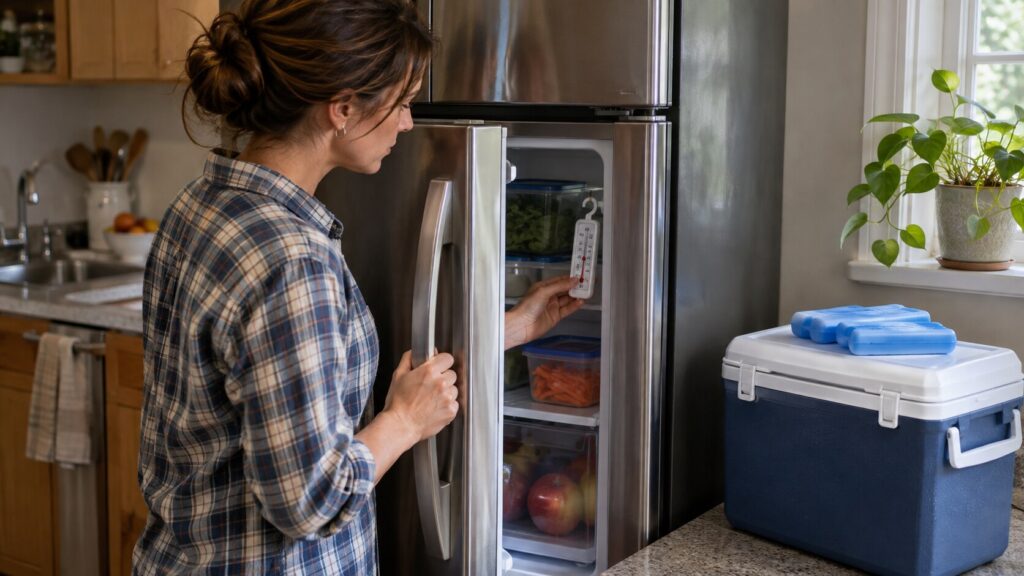
Power outage food safety starts with two facts: how warm the food became and how long it stayed there. Keep appliance doors closed, use thermometers instead of smell or appearance, and discard refrigerated perishables when the safe time-and-temperature limit has been exceeded.
A closed refrigerator generally keeps food cold for about four hours. A full stand-alone freezer holds a safe temperature for roughly 48 hours, while a half-full freezer lasts about 24 hours, provided the door stays closed. Those are planning estimates, not permission to ignore a thermometer. This guide turns the official rules into a calm, practical workflow for a home kitchen, home office or small operation.
Table of Contents
Power outage food safety rules at a glance
The refrigerator should normally operate at 40°F (4°C) or below, and the freezer at 0°F (-18°C) or below. The U.S. Food and Drug Administration recommends appliance thermometers because the control dial does not necessarily show the actual compartment temperature. A separate food thermometer is useful for checking individual packages after power returns.
- Refrigerator: treat four unopened hours as the basic planning window. After that, temperature evidence matters.
- Freezer: plan on about 48 hours when full or 24 hours when half full and unopened, according to USDA Food Safety and Inspection Service guidance.
- Frozen packages: food that still contains ice crystals or measures 40°F (4°C) or below can generally be refrozen or cooked.
- Refrigerated perishables: discard meat, poultry, seafood, eggs, milk and leftovers after four hours without power or another cold source. If monitoring shows they were above 40°F, use the stricter two-hour exposure limit.
- Uncertainty: when you cannot establish the time or temperature, choose safety rather than taste-testing.
Do not use odor, color or texture as a safety test. Harmful bacteria may be present without obvious spoilage. Cooking also does not reliably rescue food that has spent too long at unsafe temperatures because some hazards can remain even after reheating.
Prepare before the power goes out
A little preparation removes most guesswork. Put one appliance thermometer in the refrigerator and another in the freezer, where they are easy to read quickly. Test them periodically and record the normal readings. Keep a food thermometer, cooler, frozen gel packs and a marker in one known place. If outages are common, add a battery-powered or connected temperature sensor that keeps a local log; verify that its alerts still work when home Wi-Fi or mains power fails.
Freeze containers of water before a forecast storm, leaving room for expansion. They add thermal mass and can become drinking water after thawing if the containers and water were safe. Keep the freezer reasonably full, but allow cold air to circulate in the refrigerator. Group frozen packages together when an outage begins so they retain cold, while keeping raw meat separated or contained to prevent leaks.
Maintain a simple inventory of the most perishable and expensive items. The same habit used in a practical weekly meal-planning system helps you decide what to eat first and reduces repeated door opening. Note any food needed for an infant, older adult, pregnant person or someone with a weakened immune system; these groups face greater consequences from foodborne illness.
If you receive advance warning, lower appliance temperatures within their normal safe range, charge backup batteries and freeze gel packs. Locate nearby sources of block ice or dry ice before demand rises. Never handle dry ice with bare hands, never store it in an airtight container and ensure ventilation. Do not place food outdoors simply because the weather feels cold; outdoor temperatures fluctuate, animals and sunlight add risks, and the food may enter the unsafe range.
What to do during the first four hours
- Record the outage start time. A phone note, paper card or smart-home event log gives you a defensible timeline.
- Close both doors. Put a visible reminder on the handles so household members do not browse for food.
- Check utility information without opening appliances. An estimated restoration time determines whether you need coolers or ice.
- Plan one deliberate opening. If necessary, retrieve a small set of items at once, then close the door promptly.
- Use shelf-stable food first. Avoid creating new leftovers that will need refrigeration.
During a short outage, leaving food undisturbed is usually more useful than moving it. Every door opening releases cold air. The four-hour refrigerator estimate assumes the door remains closed, so it should not be treated as a countdown that permits unlimited access.
Keep an outage log if conditions are complicated: start time, door openings, sensor readings, ice added and restoration time. A shared household checklist or automated timestamp can improve decisions, but technology is supporting evidence, not a substitute for a direct temperature measurement. This is where a small workflow automation can be genuinely useful: a sensor can warn that the compartment crossed 40°F, while the log helps establish when that happened.
If someone depends on refrigerated medicine, do not apply food rules to it. Check the product labeling and contact a pharmacist, clinician or manufacturer for product-specific advice. Keep medical products separate from melting ice and food contamination.
How to handle a longer outage
When an outage is likely to exceed four hours, move refrigerated perishables to a cooler only if you can keep them at 40°F or below. Pre-chill the cooler, pack it tightly with ice or frozen gel packs, place a thermometer inside and open it sparingly. Separate raw animal products from ready-to-eat foods in leakproof containers. Add fresh ice before the temperature rises rather than after.
Prioritize high-risk foods: meat, poultry, seafood, dairy products, eggs, cooked vegetables, cut melons, cooked rice or pasta, and leftovers. Lower-risk items such as whole uncut produce, hard cheeses, butter, peanut butter, bread, mustard, pickles and many unopened shelf-stable products may not require the same response. The exact keep-or-discard decision depends on the food and its exposure, so use the FoodSafety.gov outage chart for item-level guidance.
For a freezer, resist moving packages too early. A full, closed freezer may outlast a cooler. If it is only partly full, group packages closely to slow warming. Use block ice or dry ice only with safe handling and sufficient ventilation. Never use a grill, camp stove or generator inside a home, garage, carport or near openings. The CDC advises placing generators at least 20 feet from doors, windows and vents because carbon monoxide cannot be seen or smelled.
For a home-based food business or small commercial kitchen, household guidance is not a replacement for the applicable food code, permit conditions or health-department instructions. Document temperatures, time out of control, corrective action and disposal. When required controls cannot be maintained, stop service and contact the regulator rather than improvising.
Food safety decision table
| Situation | Evidence to check | Practical decision |
|---|---|---|
| Refrigerator outage under four hours | Doors stayed closed; food was properly chilled beforehand | Food is generally expected to remain safe; verify temperature when possible |
| Refrigerated perishable above 40°F for two hours or more | Thermometer reading and exposure time | Discard; do not taste-test or try to rescue it by cooking |
| Frozen food still has ice crystals | Ice crystals in the package or food at 40°F or below | Refreeze or cook; quality may decline after refreezing |
| Frozen food fully thawed but 40°F or below | Food thermometer reading | Refreeze or cook promptly, following normal storage limits |
| Temperature history is unknown | No reliable time, log or thermometer evidence | Discard high-risk perishables |
| Food contacted floodwater | Package type and exposure | Discard unless official guidance specifically permits safe recovery |
These thresholds should be read together. “The power was out for five hours” does not automatically describe every freezer package, and “the food feels cool” does not establish a safe refrigerator history. Time gives you the first screen; temperature and ice-crystal evidence refine the decision.
What to check when power returns
When electricity returns, note the restoration time before opening a door. Read the appliance thermometer immediately. Then check representative high-risk packages with a clean food thermometer, avoiding cross-contamination. For frozen food, look for ice crystals and measure any fully thawed items. The FDA says frozen food at 40°F or below can be safely refrozen, though texture and quality may be affected.
- Separate foods into keep, cook soon and discard groups rather than repeatedly reconsidering each item.
- Photograph thermometer readings and note the time if you need records for a landlord, insurer or business file.
- Bag discarded meat or leaking packages securely and follow local waste instructions.
- Clean and sanitize surfaces that contacted leaks, dirty ice or spoiled food.
- Wait for the appliance to return to its normal operating temperature before restocking it heavily.
Do not taste food to test it. Do not rely on a smart sensor that lost connectivity unless it also stored a complete local history. If the refrigerator thermometer is above 40°F when power returns but you know the outage was brief, use the duration and food temperatures together. If you cannot determine how long high-risk food was warm, discard it.
After the immediate cleanup, review what was wasted and why. Adjust the freezer fill level, move the thermometer, improve the cooler kit or refine alerts. Add the inspection to your home maintenance schedule so batteries, thermometers and ice packs are checked before the next emergency.
Special risks: medicines, floodwater and business kitchens
Refrigerated medicines: storage requirements vary by product. The FDA directs users to the manufacturer’s labeling and product-specific safe temperature. Keep a written list of medicine names, storage ranges and contact numbers, and ask a pharmacist for an outage plan before severe weather.
Floodwater: a power failure caused by a storm may also contaminate food and water. Discard food in permeable packaging that contacted floodwater, including cardboard boxes and containers with screw caps, snap lids or pull tops. Follow local boil-water notices. The CDC’s emergency food-safety guidance covers disposal and cleaning after floods and outages.
Generators and fuel-burning appliances: refrigeration is never worth a carbon-monoxide risk. Operate generators outdoors at least 20 feet from openings, direct exhaust away from the building and use working battery-powered or battery-backup carbon-monoxide alarms. Never backfeed a home electrical system through a wall outlet; use a qualified setup appropriate to the equipment.
Business kitchens: retain the temperature log, food disposition record and any supplier or utility notices. Local rules may require discarding food sooner, notifying an authority or obtaining approval before reopening. Insurance documentation should describe the loss accurately without treating a photograph as proof that food was safe.
Practical checklist and common mistakes
- Install refrigerator and freezer thermometers and verify their readings.
- Keep coolers, gel packs, a food thermometer, gloves and leakproof bags together.
- Record the outage start and restoration times.
- Keep appliance doors closed and plan any opening.
- Use ice and a cooler only when you can maintain 40°F or below.
- Check frozen packages for ice crystals or a temperature of 40°F or below.
- Discard high-risk refrigerated food that exceeded the official limit.
- Follow separate instructions for medicine, floodwater and regulated business food.
- Review the kit and alert workflow after every outage.
The most common mistakes are opening doors repeatedly, assuming cold weather makes outdoor storage safe, tasting questionable food, trusting smell, and cooking food that has already spent too long warm. Another mistake is buying ice without measuring the cooler temperature. Ice is useful only when it keeps the food at or below the safe threshold.
A reliable plan is simple: measure temperatures, record time, keep doors closed and make conservative decisions when evidence is missing. A thermometer costs far less than replacing a full refrigerator and gives you something memory cannot provide during a stressful outage. Prepare the tools now, then follow the same documented sequence each time.