


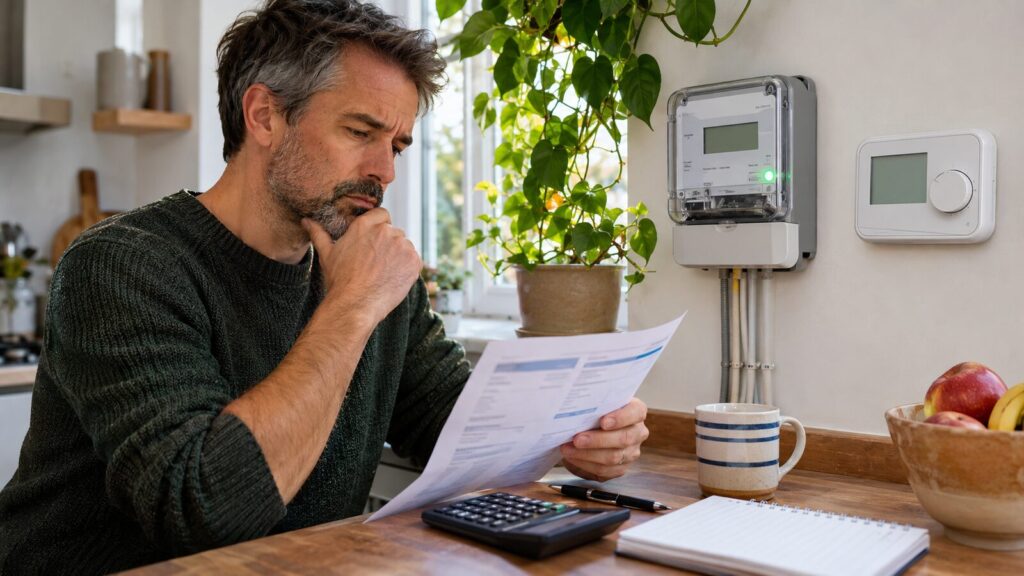
If you are asking “why is my electricity bill so high,” start by separating two possibilities: you used more energy, or the price and billing details changed. Compare the kilowatt-hours on recent bills, not just the total amount due. Then check heating and cooling, hot water, appliance use, and the utility’s rates before spending money on upgrades.
The biggest cause depends on your home, climate, heating fuel, equipment, and local tariff. The Australian Government’s energy guidance notes that heating and cooling are often the largest household energy uses there, with hot water another major load; that pattern is useful to investigate, but your own bill is the better evidence for your home. (Australian Government guide to reducing energy bills)
Read the bill before changing the house
Find the billing period, meter readings, total kilowatt-hours, rate per unit, fixed daily or monthly charges, taxes, credits, and any past-due amount. Compare the number of billed days with the prior bill. A longer period can create a larger total even when daily use has barely changed. If the bill is estimated rather than based on an actual meter reading, the next bill may correct the estimate.
Calculate average daily use by dividing kilowatt-hours by the number of days in the billing period. Compare that figure with the previous month and, if available, the same season last year. Weather can make a fair comparison difficult: a colder or hotter month may drive heating or air-conditioning use upward. Note major changes such as guests, working from home, a new appliance, a space heater, or a change in household size.
Next, check whether the rate changed. Your provider may have altered a variable rate, moved you to a new plan, added a fee, or applied a time-of-use price. If you have a time-of-use plan, the time you run appliances can matter as much as the total amount. Compare the plan’s actual rates and conditions with your usage pattern; do not assume the lowest advertised rate applies to every hour or household.
Look first at heating and cooling
Heating and cooling can run for many hours, so small changes in settings and air leaks can add up. Check the thermostat schedule and whether rooms are being heated or cooled when nobody is there. Clean or replace filters according to the equipment maker’s instructions, keep vents clear, and close doors to rooms you do not need to condition if it is safe and appropriate for the system.
Seal obvious drafts around doors and windows with suitable weatherstripping, and use curtains or blinds to limit unwanted heat gain or loss. Avoid blocking combustion-air openings or modifying fuel-burning equipment. For rented homes, ask the landlord before making permanent changes. The U.S. Department of Energy’s winter energy-saving guidance discusses thermostat settings and air sealing, but its examples and potential savings are not guarantees for every climate, system, or utility bill.
If you use portable heating or cooling appliances, check the wattage label and the hours they run. A high-wattage heater used for long stretches can be costly even if it is small. Do not use ovens, outdoor heaters, or grills to heat an indoor space; that can create fire or carbon-monoxide hazards.
Check hot water and laundry habits
Water heating can be a significant part of household energy use. Look at the heater’s temperature setting and maintenance guidance, but do not adjust a setting below the level required for safe operation in your system. If the tank is old, leaking, or making unusual noises, contact a qualified professional rather than opening electrical or gas components yourself.
For laundry, use cold water when the fabric and detergent allow, wash full loads, and choose a spin cycle that removes more water if your machine supports it. Clean the dryer’s lint filter and avoid running the dryer for longer than necessary. If line drying is practical, it can reduce dryer use. These are modest habits, not instant bill fixes, and their effect depends on how much laundry your household does.
Find the appliances that stay on for hours
Look for devices that run continuously or cycle frequently: refrigerators, freezers, dehumidifiers, pumps, aquariums, server equipment, and older entertainment systems. A fridge should remain plugged in, but make sure its door seal closes and that it has the ventilation clearance recommended by the manufacturer. If it is unusually warm, noisy, or constantly running, maintenance may matter more than a new purchase.
For optional appliances, compare the wattage label and approximate operating hours. A plug-in energy monitor can help measure some devices, but it is not appropriate for every appliance and should be used according to its instructions. Do not open a wall socket or test high-voltage equipment yourself. The Australian Government suggests turning off computers, screens, and entertainment equipment when they are not needed, while keeping essential equipment such as refrigerators and medical devices operating. Its bill-reduction guide also highlights hot water and appliance use.
If you use an air purifier, choose a unit sized for the room and the cleaning task rather than running a far larger unit by default. Globe Onward’s air purifier room-size and CADR guide explains how room dimensions and airflow ratings affect the choice. Compare actual wattage and fan settings for your model before expecting a change in electricity use.
Use a simple table to prioritize what to investigate
| What changed? | Where to check | A sensible first step |
|---|---|---|
| More kilowatt-hours | Daily use, weather, occupancy, new equipment | Compare kWh per day with a similar period |
| Higher cost per unit | Rate plan, time-of-use window, provider notice | Verify the current tariff and billing dates |
| Heating or cooling ran longer | Thermostat, filters, drafts, weather | Adjust schedules and address safe, obvious air leaks |
| Hot water use increased | Heater, showers, laundry, leaks | Reduce unnecessary hot-water use and inspect for leaks |
| Estimated meter reading | Meter-reading section | Submit a reading if your provider allows it |
| New charge or missed credit | Fees, taxes, past balance, plan change | Ask the provider to explain the line item |
This prevents a common mistake: buying a new appliance before discovering that the bill covers more days, the rate changed, or the meter reading was estimated. If the explanation still does not make sense, contact your utility with the bill in front of you and ask them to explain usage, rates, and meter readings separately.
Make one change at a time and measure it
Pick the largest likely cause and test a low-cost adjustment for a full billing cycle. Write down what changed and when. If you shift laundry to a cheaper time, compare both the time-of-use charges and total kilowatt-hours. If you adjust heating, track indoor comfort and any change in use. Changing several habits at once can make it hard to know what helped.
Use a simple log: date, meter reading or app estimate, outdoor temperature if relevant, and unusual events. Some utilities provide daily usage data, which can reveal a water heater or appliance that cycles unexpectedly. Treat an app estimate as a clue, not a final bill. If the meter appears to move when major appliances are off, contact the utility rather than opening the meter box.
During an outage, avoid repeatedly opening the refrigerator and freezer; Globe Onward’s power-outage food safety guide explains how to protect food while power is interrupted. That will not lower an ordinary bill, but it is useful household planning when energy reliability is part of the concern.
Know when a repair or upgrade is worth considering
An upgrade makes sense when an appliance is inefficient, unreliable, or near the end of its useful life, and the likely savings justify the cost. Compare the purchase price, installation, expected energy use, maintenance, warranty, and local rebates. Look for the energy label used in your country and compare models under the same test method. A large appliance may use less energy per task but still cost more upfront; the right choice depends on how often you use it.
Before replacing heating, cooling, or hot-water equipment, check whether the home’s wiring, ventilation, insulation, and utility rates support the change. Ask a qualified local installer for an estimate based on the actual space and climate. Do not rely on a generic promise that a new device will “pay for itself” in a fixed number of years; the calculation depends on your current usage, local energy prices, and how long you keep the equipment.
If payment is difficult, ask the utility about a payment plan, hardship program, or energy-assistance service in your area. Eligibility and program names vary by country and region. A billing issue or sudden cost spike can sometimes be corrected without changing the home at all.
A practical bill-check routine
When a bill looks unusually high, compare the billing days and kilowatt-hours first. Check the rate plan, meter reading, fees, and any previous balance. Then inspect the likely high-use systems: heating or cooling, water heating, and appliances that run for long periods. Choose one safe, low-cost change and compare the next bill using daily usage rather than total dollars alone.
You do not need to overhaul your home to find the cause. A careful comparison often shows whether the problem is a rate, a billing detail, a seasonal change, or a specific load. Fix the largest confirmed cause first, and spend money on equipment only when the numbers support it.